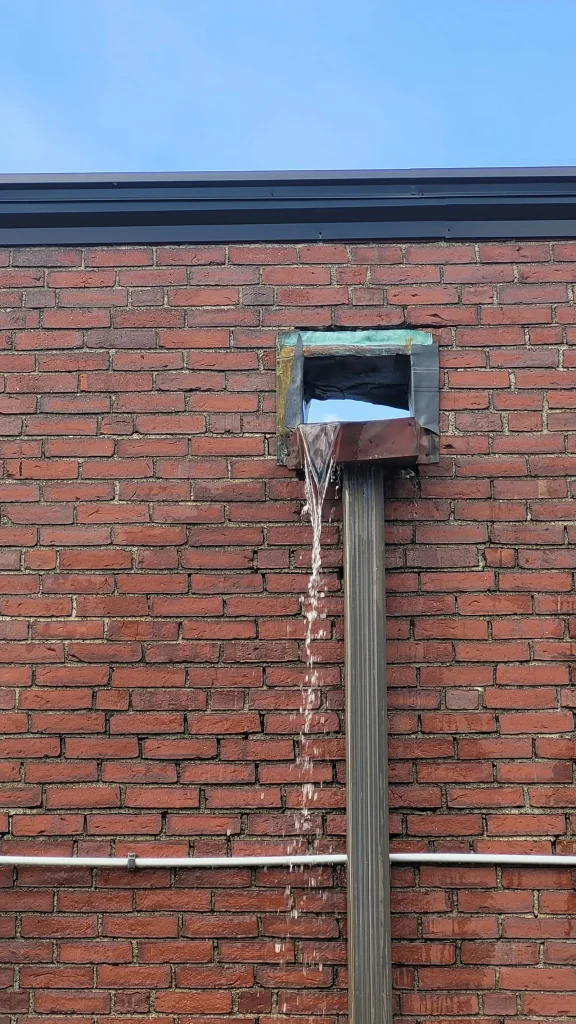
Damp patches after rain are usually a sign of penetrating damp, where rainwater is getting into the building through a defect in the roof, the rainwater goods, the walls or the windows and doors. Common causes include slipped slates or tiles, failed flashings, blocked or leaking gutters and downpipes, eroded pointing, cracked render and defective window seals. Because water can travel before it shows on an internal surface, the patch is not always beside the defect, so the cause should be traced from the outside, not assumed. This guide explains the common causes, how to tell rain-related damp from condensation, what can be checked safely and when professional advice is needed.
Why damp patches appear after rain
Government guidance defines penetrating damp as water that gets into a building from outside due to defects in the walls, roofs, windows or floors. The typical pattern is a patch that appears or grows during or shortly after rain and may fade in dry weather, often leaving staining behind. Some patches appear only in heavy downpours, when gutters are overwhelmed, or only when rain is driven against one side of the building by the wind.
Timing is not always straightforward. A saturated wall can take a considerable time to dry, so a patch may persist long after the rain has stopped.
Roof coverings and flashings
Historic England notes that damp can be caused by repairable roof faults, such as a leaking chimney, defective lead flashings, or slipped slates or tiles. Common defects include:
- Loose, slipped, broken or missing slates and tiles, including ridge, hip and valley tiles
- Splits, tears, cracks or holes in flat roof coverings
- Flashings that have lifted or come away from the wall or chimney, or have defective joints
Historic England describes the junctions that flashings protect, such as where the roof meets a chimney, as often the most vulnerable part of the roof. Inside, roof leaks typically show as staining on top-floor ceilings, damp in the loft, or damp at the head of walls and around chimney breasts.
Roof, gutter and downpipe leaks
Leaking gutters or drainpipes are, as Historic England observes, often the cause of damp walls. A single leaking joint can wet the same section of wall every time it rains. Common defects include:
- Gutters and hoppers blocked by leaves, moss or debris, so that water overflows down the face of the wall
- Leaking joints and cracked sections
- Gutters that no longer fall towards their outlets, so that water pools and spills over
- Downpipes cracked or corroded at the back, where the damage cannot be seen from the front
- Loose downpipes, and blocked gullies or broken below-ground drains that may saturate the ground at the base of the wall
Tell-tale signs outside include staining, green algae or washed-out mortar joints on the wall behind a pipe. Parapet and box gutters, and downpipes concealed within the building, are harder to inspect, and leaks from them may appear inside some distance from the source.
Walls: pointing, render and brickwork
The outer face of a masonry wall always takes up some rain, which a wall in good condition can cope with. Problems arise where defects let more water in, such as:
- Eroded, open or missing pointing
- Cracked or hollow render, which Historic England notes can allow damp into the wall behind
- Cracked, flaking or crumbling bricks and stonework
- Cement-based repairs or impermeable coatings on older walls, which may trap moisture and accelerate decay
Older solid-walled buildings behave differently from modern construction, and the choice of repair materials matters; see our guide to damp in older houses. In cavity walls, retrofitted insulation can occasionally provide a route for rainwater to cross the cavity, particularly on exposed elevations, as explained in our guide to cavity wall insulation damp.
Windows, doors and sills
Government guidance lists broken seals around windows, and windows that do not close fully, among the checks for penetrating damp. Rain can also enter through defective sills, gaps between frames and masonry, decayed timber at the base of frames, and door thresholds. Damp from these sources is usually concentrated below the corners of the frame or sill and worsens after rain. By contrast, mould around windows is more often caused by condensation.
Parapets and chimneys
Parapets and chimneys are exposed to the weather on several sides and are difficult to see closely. Signs which may indicate a problem include:
- Chimney stacks or pots that are leaning or out of position, or have vegetation growing from them
- Cracked, loose or bulging masonry and badly eroded or open joints
- Damp or staining on chimney breasts, particularly at upper levels
- Blocked parapet gutters, which may allow water into the top of the wall or the roof structure
A disused chimney should keep some ventilation, as Historic England notes that flues need airflow to prevent a build-up of dampness.
Wind-driven rain
Rain driven against a wall by strong wind can find its way through defects that remain dry in normal rain. The UK is mapped into exposure zones for wind-driven rain, and walls on exposed sites, or facing the prevailing weather, receive far more driving rain than sheltered ones. This is why damp may appear on one elevation only, or only in storms from a particular direction, so noting the wind direction when patches appear can help diagnosis.
Is it rain or condensation?
Damp patches after rain and condensation can look similar, but they usually behave differently:
| Feature | Damp from rain | Condensation |
|---|---|---|
| When it appears | During or after rain, sometimes only in storms | In cold weather, whether or not it has rained |
| Where it appears | Near a roof, chimney, pipe, sill or crack, at any height | On the coldest surfaces: window reveals, corners, behind furniture |
| What it looks like | A localised patch, often with a defined edge or staining | Diffuse dampness, often with black mould spotting and water on windows |
| Which walls | Often the most exposed elevation | Often bedrooms, bathrooms and kitchens |
The two can occur together. A wall wetted by rain is colder, and government guidance recognises that penetrating damp may make condensation worse. Damp that bears no relation to the weather may instead come from a plumbing leak, which our guide to the types of damp covers alongside the other main sources.
What you can check safely
Many defects can be spotted without leaving the ground. Historic England’s maintenance checklist recommends using binoculars to check the roof and chimney where safe access is not available, and inspecting gutters while it is raining. Sensible checks include:
- Looking for slipped slates or tiles, displaced flashings and debris on the ground
- Watching gutters, hoppers and downpipes during rain from a safe position
- Checking the back of downpipes with a mirror, and the wall behind them for staining or algae
- Looking in the loft, only where there is safe access and boarding, for staining or damp timbers
- Photographing damp patches and noting the date and weather
Climbing onto roofs or working from ladders carries real risk and should be left to competent contractors.
When to call a surveyor
Historic England advises seeking advice from a building surveyor where the source remains unclear after your own investigations, or where the problem continues. Professional advice is particularly worthwhile where:
- The source cannot be seen from the ground, or there are several possible causes
- Damp persists after gutters and downpipes have been cleared and repaired
- Damp affects upper-floor ceilings, chimney breasts or the head of walls
- The property is an older solid-walled building, or has retrofitted cavity wall insulation
- Timbers show signs of decay, or plaster is loose or bulging
- Significant works, such as re-roofing, re-rendering or water-repellent treatments, have been proposed
How an RICS Chartered Surveyor can help
An RICS Chartered Surveyor can trace damp patches after rain back to their source and distinguish rain penetration from condensation and leaks. Our damp and mould survey includes an external inspection of the roof, rainwater goods, walls and openings, moisture meter mapping, thermal imaging and readings of temperature, relative humidity and dew point. Where roof or gutter defects may be letting water in and high-level access is limited, the survey can also include a drone inspection of the roof, chimneys, parapets and gutters. The written report includes photographs, a risk rating and prioritised recommendations. As Lansdown Associates does not carry out remedial works, our recommendations are based only on the evidence.
Frequently asked questions
Why does damp only appear in heavy rain?
Some defects only admit water in particular conditions. Gutters and hoppers may cope with light rain but overflow in a downpour, and defects in walls, flashings or window seals may only leak when rain is driven against them by the wind.
Can a blocked gutter cause damp inside?
Yes. Overflowing water runs down the face of the wall and can soak through, particularly where pointing or render is defective. Historic England recommends clearing gutters and downpipes at least every autumn, after heavy leaf fall.
How long will the wall take to dry once the leak is fixed?
It depends on the construction, thickness and exposure of the wall and how wet it became. Masonry can take a considerable time to dry, so replastering and redecoration should not be rushed.
Get the cause diagnosed
If damp patches keep appearing after rain, our RICS Chartered Surveyors can find out why. For a free quotation, call 0151 374 0905 or email office@lansdownassociates.co.uk (Monday to Friday, 09:00 to 17:00). We usually respond within one working day.