
Expert witnessDamp and mould expert witness services
Lansdown Associates provides damp and mould expert witness evidence for solicitors, landlords and tenants involved in housing conditions claims. Our RICS Chartered Building Surveyors investigate the property, determine whether the damp and mould is caused by condensation, a building defect or both, and set out our opinion in a CPR Part 35 compliant report with a costed schedule of works. Our director John Jackson MRICS MEWI is a member of the Expert Witness Institute (EWI), and we accept instructions from either side or as a single joint expert.

Why damp and mould claims turn on causation
Damp and mould is the most common allegation in the housing disrepair cases we are instructed on. The central question is rarely whether mould is present. It is why it is there.
- If water is getting in through a defect in the structure or exterior, such as a leaking roof, defective rainwater goods or failed pointing, the landlord’s repairing obligations under section 11 of the Landlord and Tenant Act 1985 are likely to be engaged.
- If the mould results from condensation, the position is more complex. Condensation on its own may not amount to disrepair, but the cause may still be relevant to fitness for human habitation under section 9A, to hazards under the Housing Health and Safety Rating System (HHSRS) and, for social housing in England, to Awaab’s Law.
- Often there is more than one cause, and the expert must separate them and explain how each contributes.
Our guide to landlord repair obligations explains section 11, section 9A and the notice requirement in more detail.
A report that simply records mould and recommends treatment does not help the court decide these issues. Our reports explain the mechanism, the evidence and our reasoning. Legal conclusions remain a matter for the court and the parties’ lawyers.
How we establish the cause
Our investigation builds on the method we use for every damp and mould survey, combining a full inspection of the building with diagnostic testing, including:
- Moisture meter surveys to map the pattern and extent of dampness.
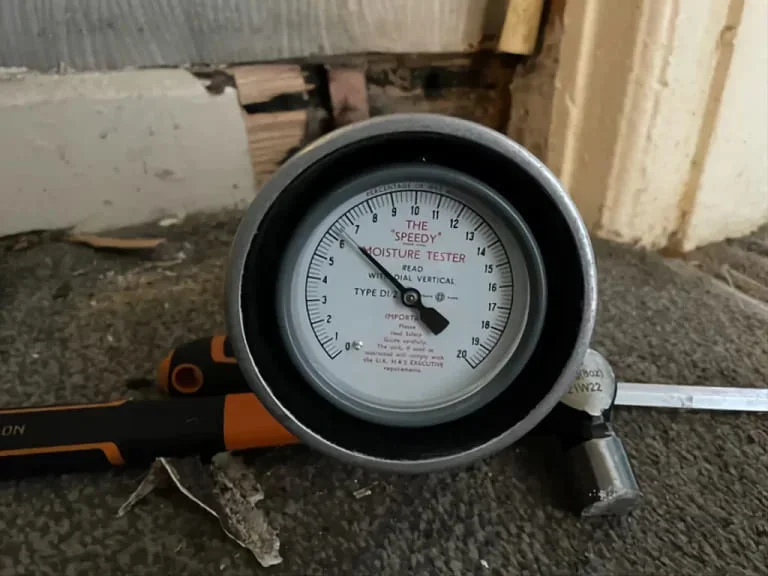
- Calcium carbide testing to measure moisture content within masonry, which surface readings alone cannot show.
- Salt analysis to help distinguish rising damp from hygroscopic salts and other sources.
- Thermal imaging to identify cold bridging, missing insulation and hidden leaks.
- Airflow analysis and assessment of ventilation, extraction and heating.
- Room-by-room readings of ambient temperature, relative humidity and dew point.
Environmental readings are only a snapshot, but they show how the home is performing. Our article on relative humidity and condensation explains how temperature and moisture interact, and our guide to the types of damp covers the differences between condensation, penetrating and rising damp.
The Pre-Action Protocol for Housing Conditions Claims
Most claims in England follow the Pre-Action Protocol for Housing Conditions Claims. For experts, the main requirements are:
- Single joint expert – the protocol encourages the parties to instruct a single joint expert. If the landlord does not object within 20 working days, the proposed expert should be instructed jointly.
- Joint inspection – where the parties cannot agree, each party’s expert can inspect at the same time.
- Timescales – the inspection should take place within 20 working days of the landlord’s response to the letter of claim, and the report should follow within 10 working days of the inspection.
- Content – the expert should provide a schedule of works, an estimate of their cost and a list of any urgent works.
- Compliance – the expert must comply with CPR Part 35, Practice Direction 35 and the Guidance for the Instruction of Experts in Civil Claims.
We plan our instructions around these timescales: we book the inspection within 5 working days of instruction and aim to provide the report within 10 working days of the inspection, in line with the protocol.
Our duty under CPR Part 35
Under CPR 35.3, an expert’s duty is to help the court on matters within their expertise, and that duty overrides any obligation to the party instructing or paying them. That is the standard we work to on every instruction, whether we are appointed by the claimant, the defendant or both. Our reports:
- Set out the substance of all material instructions.
- Record the inspection with photographs and test results.
- Address each allegation and the causation issues in turn, giving reasons.
- Where opinion ranges exist, state them and explain our view.
- Include a costed schedule of works, a list of urgent works and an estimated duration.
- Confirm that we understand and have complied with our duty to the court, with a statement of truth.
After the report is served, we answer proportionate written questions for clarification under CPR 35.6. Where the court directs, we take part in discussions with the other party’s expert, prepare joint statements setting out the issues agreed and not agreed, and give evidence in court.
Who we act for
- Claimant solicitors – independent evidence on the condition of the home, the cause of damp and mould, and the works needed.
- Defendant solicitors and landlords – social landlords, local authorities and private landlords needing an objective assessment of the allegations. We currently act as expert witness for social housing providers.
- Parties jointly – as a single joint expert under the protocol or a court direction.
Because we act for both sides, our opinions are balanced by experience of how claims are put and defended. For claims covering a wider range of defects, see our housing disrepair survey service.
Example: condensation, not a roof leak
In one instruction, the occupants alleged a roof leak and relied on an expert report supporting their claim. Our surveyor recorded an ambient temperature of 14°C and relative humidity of 85%. Using psychrometric data, we showed how raising the temperature to normal levels of 18 to 21°C would significantly reduce the relative humidity and the risk of condensation. Our Part 35 report concluded there was no evidence of a statutory breach giving rise to the issues identified. Read the full housing disrepair case study.
Why instruct Lansdown Associates?
- John Jackson MRICS MEWI is an experienced expert witness and a member of the Expert Witness Institute.
- Our surveyors are RICS Chartered Building Surveyors with practical experience of diagnosing building defects.
- We are independent. We do not sell damp treatments or carry out works, so we have no commercial interest in the outcome.
- Where needed, we carry out carbide, salt and environmental tests to measure the moisture in the wall itself.
- We have offices in Liverpool, Manchester and London and accept expert witness instructions for properties across England and Wales, including London, Birmingham, Liverpool, Manchester and Leeds.
Frequently asked questions
Can you act as a single joint expert?
Yes. The Pre-Action Protocol encourages single joint experts, and we accept instructions on that basis as well as from one party.
Can you review another expert’s damp report?
Yes. We can review an existing report, identify where the evidence supports or does not support its conclusions, and set out our own opinion within the scope of our instructions and any court directions.
Do you prepare joint statements and give evidence in court?
Yes. Where the court directs, we take part in expert discussions, prepare joint statements with the other party’s expert and give evidence in court. We accept expert witness instructions for properties in England and Wales.
What do you need from us to accept an instruction?
The letter of claim or schedule of allegations, draft or agreed letter of instruction, property address, access arrangements, and any existing reports or repair records.
Do you provide a costed schedule of works?
Yes. Every report includes a costed schedule of works, identifies urgent items and gives an estimated duration.
Instruct a damp and mould expert witness
To check availability, discuss a new instruction or request a free quotation, call 0151 374 0905 or email office@lansdownassociates.co.uk, Monday to Friday, 09:00 to 17:00. We usually respond within one working day.
Related services
- Damp and mould surveys – independent investigations outside litigation.
- Housing disrepair surveys – CPR Part 35 reports on all types of residential disrepair.
- Schedule of condition surveys – a dated photographic record of condition.